

Fiber optic networks have become the backbone of modern internet infrastructure. From FTTH connections and enterprise broadband to telecom backhaul systems, fiber networks are expected to deliver uninterrupted high-speed connectivity at all times. However, despite their reliability, fiber optic networks are still vulnerable to failures that can lead to downtime, customer dissatisfaction, revenue loss, and operational chaos for ISPs.
As networks expand rapidly, many service providers struggle to maintain accurate visibility of their fiber infrastructure. Small issues often go unnoticed until they evolve into major outages. Understanding the most common causes of fiber network failures is the first step toward building a more reliable and scalable ISP operation.
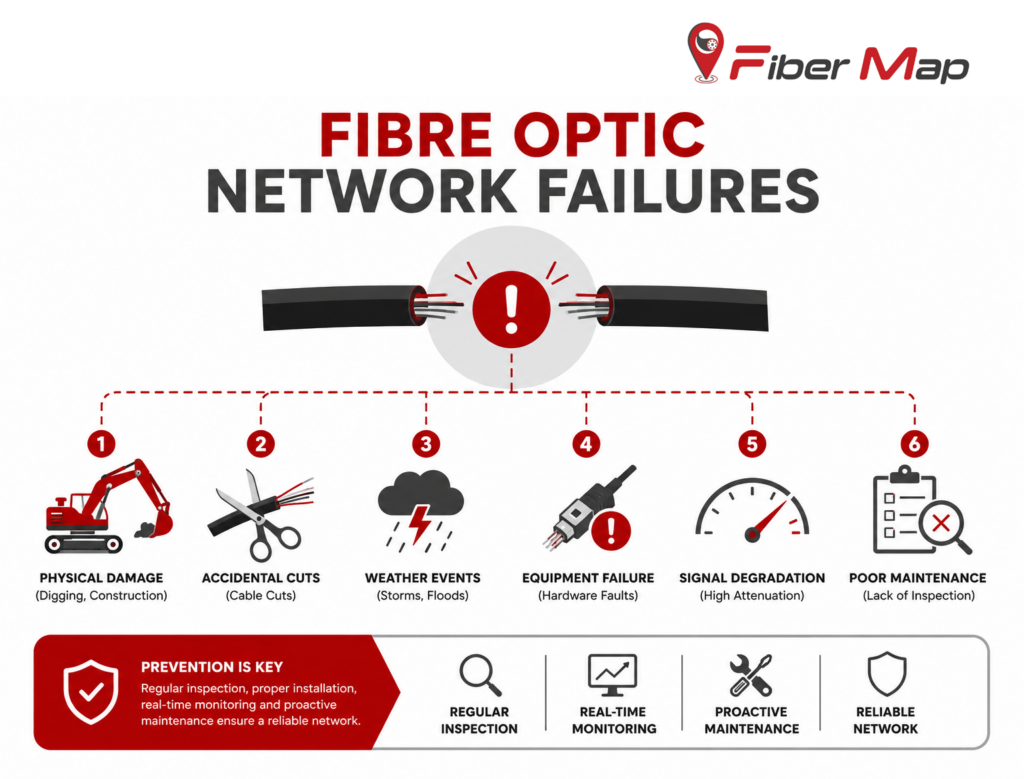
Physical Damage Remains the Biggest Threat
One of the most common reasons behind fiber optic network failures is physical cable damage. Construction work, road digging, utility repairs, or accidental excavation can easily cut underground fiber routes. Even a minor cable break can disrupt services for hundreds or thousands of users.
Unlike copper networks, fiber cables are delicate and require precise handling. Improper installation practices, excessive cable bending, or poor joint closures can weaken the network over time. In many cases, ISPs discover that outdated documentation makes it difficult to identify the exact location of damaged fiber lines, resulting in longer restoration times.
Maintaining updated fiber route visibility is essential for reducing the impact of physical damage and speeding up fault resolution.
Connector and Splicing Issues Cause Signal Loss
Fiber connectors and splicing points are highly sensitive components within a network. Dust, poor alignment, damaged connectors, or low-quality splicing can lead to signal attenuation and unstable connectivity.
These issues may not immediately cause a complete outage, but they gradually reduce network performance. Customers may experience slow internet speeds, packet loss, or intermittent disconnections before the actual fault becomes visible.
Routine inspection and preventive maintenance help detect these weak points early. ISPs that ignore minor signal degradation often face repeated maintenance visits and higher operational costs.
Environmental Factors Can Damage Fiber Infrastructure
Weather conditions also play a major role in fiber network failures. Flooding, heavy rainfall, extreme heat, and storms can damage outdoor equipment and underground infrastructure.
Water ingress into closures or damaged ducts can affect fiber quality and create recurring faults. In coastal or high-humidity regions, environmental exposure accelerates equipment deterioration.
As fiber deployments grow into rural and remote areas, environmental monitoring becomes increasingly important. ISPs must ensure that their infrastructure is properly protected and documented to handle changing field conditions.
Poor Documentation Slows Down Fault Resolution
Many ISPs still depend on spreadsheets, paper records, or disconnected systems to manage fiber infrastructure. As networks expand, these methods become unreliable and difficult to maintain.
When a fault occurs, field teams often waste valuable time identifying the affected fiber route, splitter location, splice point, or connected customers. Inaccurate documentation leads to confusion, delayed restoration, and repeated human errors.
Without a centralized view of the network, even experienced teams struggle to diagnose issues efficiently. Modern ISPs require real-time infrastructure visibility to improve operational accuracy and reduce downtime.
Lack of Proactive Monitoring Increases Network Downtime
Reactive maintenance is one of the biggest operational challenges in growing ISP networks. Many failures are only addressed after customers report service disruptions.
Without proactive monitoring systems, ISPs cannot identify warning signs such as signal degradation, repeated faults, or overloaded infrastructure. By the time the issue is discovered, customer experience has already been affected.
Proactive monitoring allows operators to identify risks early, schedule preventive maintenance, and reduce unexpected outages. This approach improves SLA performance while reducing long-term operational expenses.
The Importance of Faster Fault Detection
As subscriber expectations continue to rise, network downtime directly impacts customer trust and brand reputation. Faster fault detection has become a critical requirement for ISPs aiming to scale efficiently.
Modern fiber operations require accurate infrastructure mapping, live network visibility, and simplified fault tracing. When teams can instantly locate affected fiber routes and equipment, restoration becomes significantly faster and more reliable.
How FiberMap Helps ISPs Detect Fiber Issues Faster
FiberMap helps ISPs visualize fiber routes, splitters, joints, and network equipment from a centralized platform. With accurate infrastructure visibility, field teams can identify fault locations faster and reduce restoration delays.
By replacing manual documentation with digital fiber mapping, FiberMap minimizes operational errors, improves maintenance efficiency, and helps ISPs manage growing fiber networks with greater accuracy and reliability.