

Fiber-to-the-Home (FTTH) networks have become the foundation of modern broadband services, delivering gigabit speeds and reliable connectivity to residential and enterprise subscribers alike. However, as fiber deployments expand, so does the complexity of operating and maintaining them.
For ISP operations teams, the challenge is rarely just fixing a fault—it’s identifying the exact location and root cause before subscribers begin flooding the helpdesk with complaints. A single issue in the Optical Distribution Network (ODN) can trigger hundreds of support tickets, consume valuable engineering resources, and significantly increase Mean Time to Repair (MTTR).
Understanding the most common FTTH faults and adopting an intelligent approach to troubleshooting can dramatically improve operational efficiency. More importantly, modern network intelligence platforms now enable ISPs to automate much of this process.
Fiber Cuts: The Most Disruptive Failure in an FTTH Network
Among all network faults, fiber cuts have the highest operational impact. Whether caused by road excavation, construction activities, rodent damage, or accidental cable handling, a break in a feeder fiber can disconnect hundreds of subscribers connected through passive splitters.
Although Optical Line Terminals (OLTs) immediately generate Loss of Signal (LOS) alarms, they only indicate that a failure exists—not where it occurred. Engineers must often correlate OLT alarms, OTDR traces, fiber route documentation, and field records before locating the damaged section.
Without accurate network visibility, restoration becomes a time-consuming manual process that delays customer recovery and increases operational costs.
Connector Contamination: Small Defects with Significant Impact
Not every service issue originates from a major cable failure. Connector contamination remains one of the most overlooked causes of degraded FTTH performance.
Dust particles, oil residue, or microscopic scratches on APC or UPC connectors increase insertion loss and optical reflections, pushing the optical link beyond its designed power budget. The result is often intermittent connectivity, fluctuating receive power levels, frequent ONU re-registrations, or unexplained reductions in throughput.
Because these symptoms closely resemble other network issues, connector faults are frequently misdiagnosed, leading to unnecessary technician dispatches and prolonged troubleshooting cycles.
Excessive Fiber Bending and Optical Attenuation
Fiber cables are designed to operate within specific bend radius limits. When installers exceed these limits—whether inside distribution cabinets, splice closures, or customer premises—the optical signal experiences increased attenuation.
Unlike a complete fiber break, macro-bends and micro-bends usually create intermittent service degradation rather than total outages. Subscribers may experience unstable connections, fluctuating latency, or inconsistent bandwidth, making these faults particularly difficult to isolate.
Detecting bend-related attenuation typically requires both optical power measurements and an understanding of the physical fiber route.
High-Loss Fusion Splices
Every fusion splice introduces a small amount of optical loss. When splice preparation is poor, fiber ends are contaminated, or fusion equipment is improperly calibrated, insertion loss increases significantly.
These high-loss splice points gradually degrade signal quality across downstream subscribers and often remain undetected until service quality begins to deteriorate.
Routine splice validation and OTDR analysis remain essential for maintaining long-term network reliability, particularly in large GPON and XGS-PON deployments.
Passive Splitter Degradation
Passive optical splitters are among the most critical components within an FTTH network because they distribute optical signals from a single feeder fiber to multiple subscribers.
A damaged splitter, incorrect split ratio, or excessive insertion loss affects every subscriber connected to that branch of the Optical Distribution Network.
Since splitters themselves generate no alarms, identifying these failures traditionally requires engineers to compare optical power levels across multiple ports while manually tracing the network topology.
ONU, OLT and Provisioning Issues
Not every subscriber outage is caused by the physical fiber infrastructure.
Provisioning errors, authentication failures, faulty ONTs, damaged SFP modules, or incorrect service profiles can all prevent successful subscriber registration even when the optical path remains healthy.
Diagnosing these issues often requires engineers to switch between multiple operational platforms—including AAA servers, TR-069 ACS, Network Management Systems (NMS), SNMP monitoring tools, inventory databases, and provisioning systems—to verify subscriber status.
The challenge is no longer collecting data; it is correlating data from multiple systems quickly enough to identify the true root cause.
Why Traditional FTTH Troubleshooting Doesn’t Scale
As subscriber bases grow into tens or hundreds of thousands, traditional troubleshooting methods become increasingly inefficient.
Support engineers often navigate multiple dashboards to answer a single question:
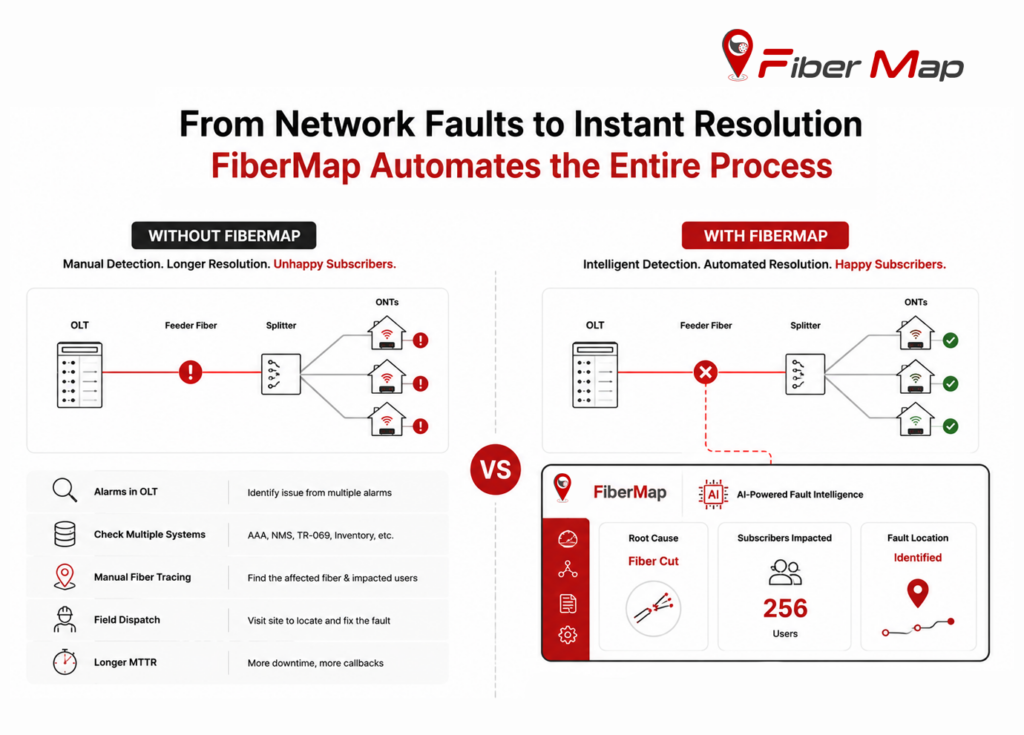
Where exactly is the fault?
A typical investigation may involve:
- Checking AAA session status
- Reviewing OLT alarms
- Verifying TR-069 device communication
- Inspecting SNMP events
- Searching inventory records
- Tracing fiber routes manually
- Reviewing historical fault tickets
Each system provides only part of the picture. The absence of a unified network view forces operations teams to spend more time correlating information than resolving the actual issue.
From Reactive Troubleshooting to Intelligent Network Operations
Modern ISP operations require more than fault monitoring—they require fault correlation.
Rather than treating every subscriber complaint as an isolated incident, operators need to understand how network events, subscriber sessions, fiber topology, and infrastructure are interconnected.
When multiple subscribers simultaneously lose connectivity, the objective is not simply to generate alarms. It is to determine whether the issue originates from a feeder cable, distribution fiber, splitter, OLT, ONT, or customer premises equipment—and to identify every subscriber affected by that failure.
This level of intelligence transforms troubleshooting from reactive investigation into proactive network operations.
How FiberMap Automates the Entire Fault Resolution Process
FiberMap was designed to provide ISPs with a complete, real-time understanding of their FTTH network—from the subscriber’s ONT through splitters, distribution fibers, feeder cables, OLTs, aggregation switches, and core infrastructure.
By integrating data from AAA, TR-069, SNMP, NMS, inventory systems, and network topology, FiberMap continuously correlates operational information across the entire network.
Instead of manually switching between multiple platforms, operations teams gain a unified view that enables them to:
- Instantly visualize the complete fiber path serving an affected subscriber.
- Correlate alarms across multiple systems to identify the most probable root cause.
- Detect network-wide incidents such as fiber cuts and immediately determine all impacted subscribers.
- Understand relationships between passive infrastructure, active devices, and subscriber services from a single interface.
- Automatically generate actionable diagnostics that accelerate troubleshooting and reduce unnecessary field visits.
- Support AI-powered helpdesks, chatbots, and voice agents with real-time network intelligence for faster customer assistance.
Rather than responding to faults one ticket at a time, FiberMap enables ISPs to identify, analyze, and resolve network issues at their source. The result is lower Mean Time to Repair (MTTR), reduced operational overhead, fewer repeat support calls, and a significantly better subscriber experience.
Ready to automate FTTH fault detection and simplify network operations?
Explore FiberMap to see how real-time network intelligence, AI-powered diagnostics, and end-to-end fiber visibility can help your team resolve issues faster, reduce MTTR, and deliver a superior subscriber experience.