

The demand for high-speed internet continues to grow as businesses, households, and smart technologies become increasingly dependent on reliable connectivity. To meet this demand, Internet Service Providers (ISPs) are accelerating their Fiber-to-the-Home (FTTH) deployments, expanding network coverage to new communities and increasing capacity in existing service areas.
However, expanding a fiber network is rarely a straightforward process. While fiber technology offers unmatched speed and reliability, the journey from planning and deployment to ongoing operations presents several challenges. As networks grow larger and more complex, managing infrastructure, maintaining accurate records, and ensuring operational efficiency become critical to long-term success.
Understanding these challenges—and implementing the right strategies to address them—can help ISPs scale their FTTH networks more effectively while controlling costs and maintaining service quality.
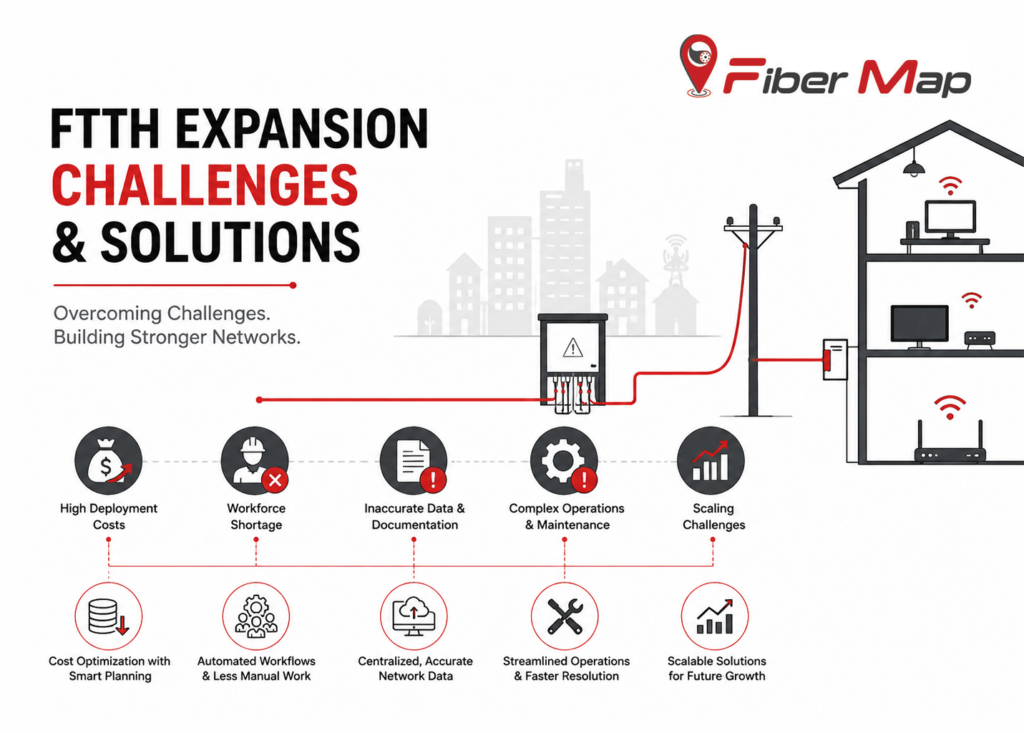
1. Inaccurate Network Documentation
One of the most common challenges during FTTH expansion is maintaining accurate network documentation. As new routes, splice points, splitters, cabinets, and subscriber connections are added, network records can quickly become outdated if they are not updated consistently.
Many operators still rely on spreadsheets, static diagrams, or disconnected systems to document network assets. Over time, these methods become difficult to maintain, leading to missing information, duplicate records, and inconsistencies between field conditions and documented data.
Poor documentation can create significant operational challenges. Technicians may struggle to locate network assets, planning teams may work with inaccurate information, and troubleshooting efforts can take considerably longer than necessary.
2. Limited Visibility into Network Infrastructure
As fiber networks expand across multiple regions, gaining a complete view of the infrastructure becomes increasingly difficult. Network teams need visibility into fiber routes, distribution points, splice closures, customer connections, and equipment locations to effectively manage operations.
Without a centralized view of the network, planning future expansions becomes more complicated. Identifying available capacity, understanding route dependencies, and evaluating the impact of network changes can require significant manual effort.
Limited visibility often results in slower decision-making, increased operational costs, and greater risk during network upgrades or maintenance activities.
3. Complex Fiber Route and Splice Management
A growing FTTH network can contain thousands of fiber strands and splice connections. Tracking how these fibers are connected throughout the network becomes increasingly challenging as the infrastructure expands.
When network records are incomplete or difficult to access, engineers may spend hours tracing fiber paths and verifying splice information. Even a minor documentation error can lead to prolonged troubleshooting efforts and service disruptions.
Effective fiber route and splice management is essential for maintaining network reliability and supporting future expansion projects.
4. Inefficient Field Data Collection
Field surveys and site inspections play a crucial role in every FTTH deployment. During construction and maintenance activities, technicians collect information about fiber routes, poles, handholes, cabinets, and customer connections.
However, when this data is recorded manually and transferred later into network records, the risk of errors increases significantly. Missing updates, inaccurate locations, and inconsistent asset information can create long-term documentation challenges.
As deployment projects scale, inefficient data collection processes can slow down network rollouts and reduce overall operational efficiency.
5. Increasing Complexity of Fault Resolution
Network faults become more difficult to manage as fiber infrastructure expands. A single fiber cut or equipment failure can impact hundreds of subscribers, making rapid fault identification and resolution a top priority for operators.
Without accurate network information, technicians may struggle to determine the affected routes, locate damaged infrastructure, or understand the extent of the outage. This can increase downtime, raise operational costs, and negatively impact customer satisfaction.
As subscriber expectations continue to rise, operators need efficient processes for identifying and resolving network issues as quickly as possible.
6. Scaling Infrastructure for Future Growth
FTTH expansion is not just about meeting current demand. ISPs must also prepare for future subscriber growth, increased bandwidth requirements, and emerging technologies.
Networks that are built without long-term scalability in mind often encounter operational bottlenecks as they grow. Capacity planning becomes more difficult, infrastructure upgrades take longer, and maintaining service quality becomes increasingly challenging.
A sustainable expansion strategy requires operators to think beyond immediate deployment goals and build a strong operational foundation for future growth.
Strategies for Successful FTTH Expansion
While the challenges of FTTH expansion can vary depending on network size and deployment geography, successful operators often follow several common practices to improve efficiency and support long-term growth.
Centralize Network Documentation
Maintaining a single source of truth for network records helps ensure consistency across planning, deployment, and maintenance teams. Accurate documentation reduces errors, improves collaboration, and simplifies network management.
Improve Infrastructure Visibility
Having a complete view of fiber assets, routes, and connections enables operators to make better decisions and respond more effectively to operational challenges. Greater visibility also supports more efficient capacity planning and network expansion.
Digitize Field Operations
Modern field data collection methods help eliminate manual processes and improve data accuracy. Capturing network information directly from the field ensures that records remain current and aligned with real-world conditions.
Streamline Fault Management
Combining accurate network documentation with real-time monitoring and intelligent diagnostics can significantly reduce troubleshooting times. Faster fault isolation leads to reduced downtime and improved customer experience.
Plan for Long-Term Scalability
Network expansion strategies should account for future growth from the beginning. Building scalable processes and maintaining accurate infrastructure records make it easier to support new subscribers, expand coverage areas, and upgrade network capacity over time.
FTTH expansion presents significant opportunities for ISPs, but it also introduces new operational challenges that become more complex as networks grow. Accurate documentation, infrastructure visibility, efficient field operations, and proactive fault management are essential components of a successful expansion strategy.
Operators that invest in modern network management practices are better positioned to accelerate deployments, improve operational efficiency, and deliver reliable broadband services to their subscribers.
FiberMap helps ISPs digitally map, document, and manage their fiber infrastructure with GIS-based network visualization, fiber path management, geo-tagging, and AI-powered fault detection.
Discover how FiberMap can simplify network expansion and support scalable FTTH growth.