

Fiber networks are becoming larger, more distributed, and more complex to operate. As operators add subscribers, expand FTTH coverage, deploy more equipment, and manage multi-vendor infrastructure, knowing where network assets are is no longer enough. The next step is understanding how those assets are connected, how the network is performing, and what could happen when conditions change.
This is where a fiber network digital twin becomes valuable.
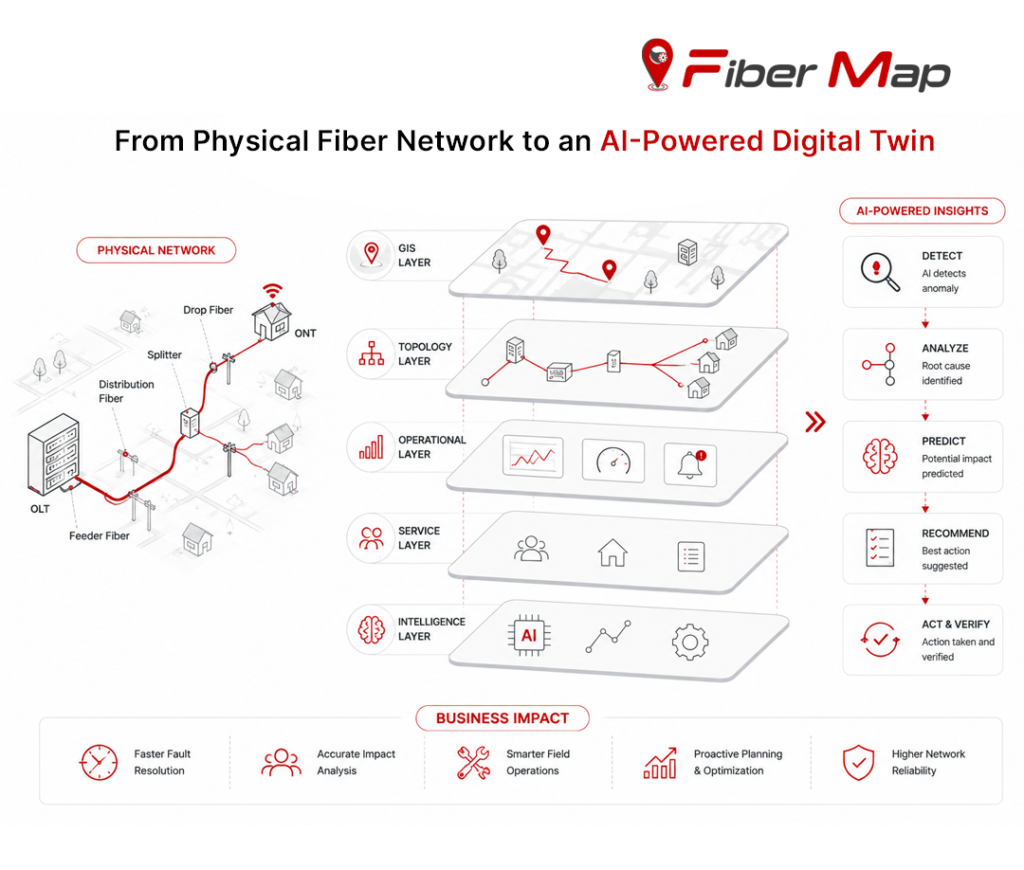
A fiber network digital twin is a virtual representation of a physical fiber network that combines GIS data, network topology, asset information, operational data, and analytics in a connected digital environment. Unlike a static network map, a digital twin can provide a dynamic view of the network and support analysis, prediction, and optimization.
What Is a Fiber Network Digital Twin?
A digital twin creates a digital representation of the physical network and its relationships.
For a fiber operator, this can include:
- OLTs, ONTs, splitters, cabinets, poles, and fiber cables
- Geographic routes and infrastructure locations
- Fiber cores, splices, ports, and connectivity
- Subscriber and service information
- Device performance and network telemetry
- Alarms, faults, and operational events
The value comes from connecting these data points rather than keeping them as isolated records.
For example, when a fiber segment fails, a digital twin can help answer more than “where is the fault?” It can help identify which network elements are connected to the affected segment, which subscribers may be impacted, and where technicians need to intervene.
Recent developments in telecom show digital twins moving beyond planning and offline analysis toward continuously synchronized, AI-assisted network operations. Ericsson describes this evolution as a shift toward predictive and interactive digital twins that can test network changes before they affect the live environment.
Fiber Map vs. Fiber Network Digital Twin
A GIS fiber map remains an essential foundation, but a digital twin extends its capabilities.
A traditional fiber map primarily answers:
Where is the network?
A connected digital twin can help answer:
How is the network connected?
What is happening now?
What will be affected by a network event?
What could happen if a change is made?
This distinction is important as operators move toward more automated network operations. Ciena notes that the combination of increasing network complexity and AI-driven autonomous operations is making network digital twins increasingly practical.
The Data Layers Behind a Fiber Digital Twin
A useful fiber network digital twin brings together multiple layers of information.
1. Geospatial Layer
The GIS layer establishes the physical context of the network. It can include roads, buildings, poles, ducts, fiber routes, cabinets, and other infrastructure.
Accurate field and base-mapping data are particularly important because they provide reliable inputs for engineering, permitting, construction, and subsequent network operations. The Fiber Broadband Association’s 2026 engineering guidance specifically highlights accurate field data and GIS/CAD integration as foundations for better broadband deployment.
2. Physical and Topology Layer
This layer describes how network components are physically connected.
Instead of simply showing a cable on a map, topology can represent relationships such as:
OLT → Feeder Fiber → Splice → Splitter → Distribution Fiber → ONT
This connectivity becomes critical for route tracing, fault isolation, maintenance, and subscriber impact analysis.
3. Operational Layer
The digital twin can incorporate operational information such as device status, alarms, performance measurements, and network telemetry.
When geographic, topology, and operational data are connected, an operator can move from simply locating an asset to understanding its current condition.
4. Service and Subscriber Layer
The network ultimately exists to deliver services. Connecting subscriber and service information to network topology allows operators to understand the business impact of infrastructure events.
A fault on one fiber segment, for example, can potentially be correlated with the downstream subscribers and services dependent on that segment.
5. Intelligence Layer
AI and analytics can sit above these connected data layers to identify patterns, correlate events, predict potential issues, and support operational decisions.
This reflects a broader industry movement toward AI-powered network intelligence. Recent fiber industry developments are increasingly focused on moving from reactive maintenance toward proactive network performance management and data-driven operations.
How Can a Digital Twin Improve Fiber Network Operations?
A connected digital twin can support several operational use cases:
Faster fault analysis: Trace a fault through the network topology and identify potentially affected infrastructure.
Impact analysis: Determine which downstream assets, services, or subscribers may be affected.
Predictive maintenance: Combine historical and real-time data to identify conditions that could indicate an emerging problem.
Network planning: Evaluate routes, capacity, and infrastructure requirements before making physical changes.
Field operations: Give technicians a clearer representation of the assets and connectivity they need to inspect.
What-if analysis: Test potential network changes or scenarios digitally before applying them to the live network.
The long-term opportunity is to move from a network that is simply mapped and monitored to one that is understood, analyzed, and increasingly optimized through data and AI.
Building the Foundation for AI-Powered Fiber Operations
AI cannot produce reliable network intelligence from disconnected or inaccurate data. A useful digital twin therefore starts with a reliable digital representation of the physical network.
GIS accuracy, asset records, fiber topology, device information, operational telemetry, and subscriber relationships all contribute to that foundation.
As fiber networks scale, the ability to connect these layers can become as important as the ability to visualize them.
The evolution from GIS fiber mapping to a fiber network digital twin represents a shift from simply knowing where network infrastructure exists to understanding how the network behaves as a connected system. For operators looking to improve visibility, fault analysis, network planning, and AI-driven operations, a connected and continuously updated network view can provide the foundation for smarter decisions.
FiberMap brings GIS-based fiber network mapping, connectivity visibility, network monitoring, and AI-powered insights together in one platform. Explore FiberMap to see how a digital view of the physical network can help transform fiber network operations.