

A fiber network can have excellent equipment and still become difficult to expand, troubleshoot, or maintain if its architecture is poorly planned. For ISPs, choosing the right FTTH network architecture affects fiber requirements, splitter placement, deployment cost, subscriber expansion, field operations, and long-term network visibility.
Modern FTTH deployments commonly use Passive Optical Network (PON) architectures, where an OLT connects to ONTs/ONUs through an Optical Distribution Network (ODN). Within this framework, ISPs can organize their physical network using approaches such as centralized split, distributed split, star, and daisy-chain architectures.
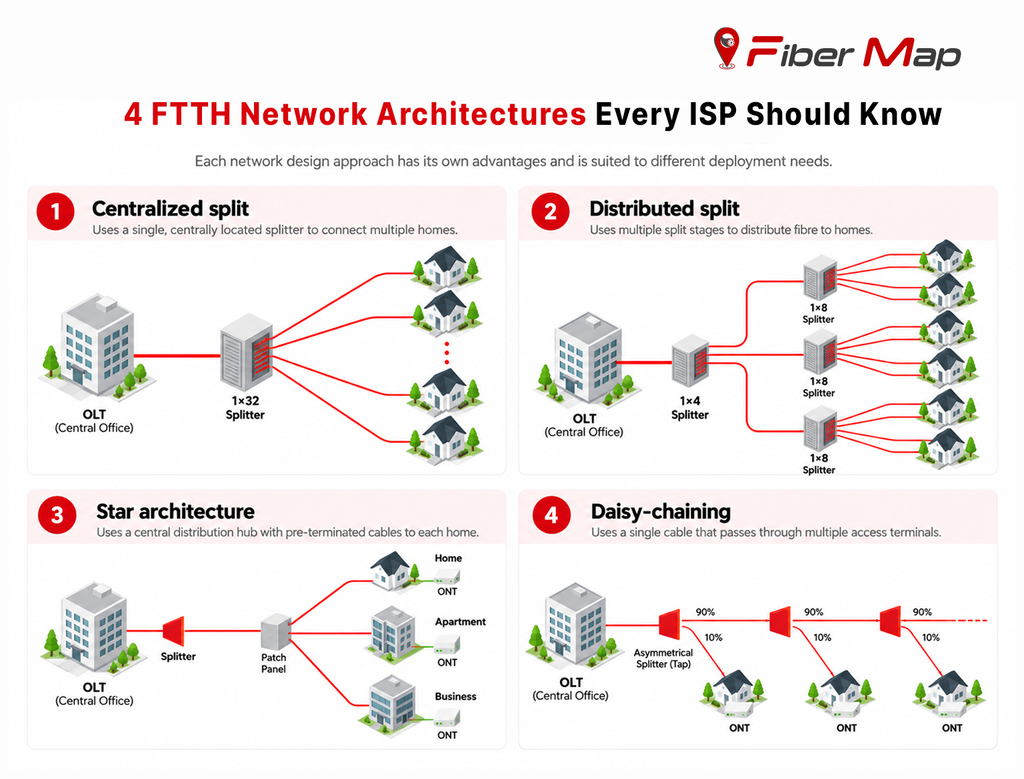
1. Centralized Split: Maximum Flexibility
A centralized split architecture places the primary optical splitter at a central distribution location. Individual fibers then run from the splitter toward distribution points and subscribers.
The major advantage is flexibility. Because subscriber fibers are individually managed from a central point, network teams can more easily identify connections, make changes, and support future subscriber requirements.
The trade-off is higher fiber demand. More individual fibers may need to travel from the centralized location, increasing cable requirements, space utilization, splicing, and installation effort.
This architecture can be useful where subscriber density is relatively low or where an ISP prioritizes straightforward connectivity and easier service management.
2. Distributed Split: Efficient for High-Density Networks
A distributed split architecture uses multiple splitter stages across the network. Instead of bringing every subscriber fiber back to one central location, an initial splitter can feed smaller downstream splitters positioned closer to subscriber clusters.
This can reduce fiber requirements across parts of the distribution network and make better use of available infrastructure. It can be particularly effective in dense urban areas where many subscribers are located within defined service zones.
However, cascading splitters requires careful planning. Splitter locations, accessibility, optical loss, and fault isolation all become important considerations. Fiber length, connectors, splices, and splitters contribute to optical loss, so the complete ODN must remain within the optical power budget of the selected PON system.
3. Star Architecture: Simpler Connectivity, More Fiber
In a star architecture, individual fibers or pre-terminated connections are routed from a central location toward distribution points or subscribers.
One advantage is reduced field splicing. With fewer splices required at intermediate locations, installation and physical connectivity can be easier to manage. It can also provide a straightforward view of individual subscriber connections.
The downside is cable consumption. Multiple connections may need to travel back toward a central location, increasing cable requirements and potentially raising installation costs.
For ISPs, the decision becomes a balance between simpler connectivity and the additional fiber and infrastructure required.
4. Daisy-Chain Architecture: Efficient Deployment with Trade-Offs
A daisy-chain architecture passes a cable through multiple fiber access or distribution points, with subscriber connections branching along the route.
This approach can reduce material and labor requirements compared with some fully centralized designs. It can work well where subscribers are distributed along a relatively continuous route.
However, the shared path introduces additional operational considerations. Network planners need to carefully consider access-point placement, splicing, restoration procedures, and future expansion. Changes or faults along a shared section can have implications for downstream connections.
How Should an ISP Choose the Right FTTH Architecture?
There is no single FTTH architecture that is best for every ISP. The right choice depends on the physical network, subscriber profile, growth plans, and operational requirements.
Subscriber density: Dense urban areas may favor distributed designs, while lower-density areas may benefit from centralized connectivity.
Geography: Roads, buildings, poles, ducts, distances, and existing fiber routes influence where splitters and distribution points can be placed.
Future growth: Architecture should accommodate subscriber additions without requiring major redesign or excessive new infrastructure.
Optical power budget: Split ratios, fiber distance, connectors, splices, and other components must be evaluated together to ensure the optical design remains within the capabilities of the selected PON technology.
Operations and maintenance: Technicians need clear visibility into OLTs, splitters, splice points, routes, ports, and subscriber connections.
Upgrade strategy: PON technologies can evolve while reusing parts of an existing ODN. ITU-T G.9805 describes methods for enabling multiple PON generations to coexist on a common ODN, making accurate records of existing fiber and splitter infrastructure increasingly valuable.
Why FTTH Architecture Needs Network Visibility
Designing the physical network is only the beginning. As an FTTH network grows, ISPs need to understand how every OLT, splitter, fiber route, ONT, and subscriber is connected.
A GIS-based network management approach can provide a connected view of physical infrastructure and network relationships. Instead of relying on disconnected spreadsheets, drawings, or outdated field records, teams can use mapped network data to trace connectivity, support technicians, identify assets, and plan future expansion.
This becomes particularly important when an ISP operates different architectures across different service areas.
Build a Smarter FTTH Network with FiberMap
FiberMap helps ISPs map and manage their FTTH infrastructure from OLT to subscriber. With GIS-based visibility of OLTs, ONTs, splitters, fiber routes, poles, joint closures, and network connectivity, teams can maintain a clearer picture of how their network is built and how it is evolving.
Whether your deployment uses centralized splits, distributed splits, star-based connectivity, or another FTTH architecture, FiberMap brings the physical network and its connectivity into one connected view—making network planning, troubleshooting, and expansion easier to manage.