

The global demand for high-speed broadband connectivity continues to increase across residential communities, commercial buildings, smart infrastructure projects, and underserved regions. As digital consumption grows, Internet Service Providers (ISPs) are under increasing pressure to deploy FTTH (Fiber-to-the-Home) networks that are scalable, reliable, and operationally efficient.
A well-planned FTTH network supports long-term expansion, improves service quality, and reduces maintenance complexity. In contrast, poorly structured deployments often lead to signal degradation, network congestion, high operational costs, and delayed service activation.
Modern FTTH deployment involves much more than laying fiber cables. Network architecture, route planning, splitter design, documentation, and infrastructure visibility all play a major role in determining long-term network performance.
Core Components of an FTTH Network
FTTH is a broadband architecture where fiber optic cables extend directly from the ISP network to customer premises. Compared to traditional copper-based infrastructure, FTTH networks offer:
- Higher bandwidth capacity
- Lower latency
- Better signal stability
- Greater scalability for future demand
Most modern deployments are built using Passive Optical Network (PON) technologies such as:
- GPON
- XGS-PON
- EPON
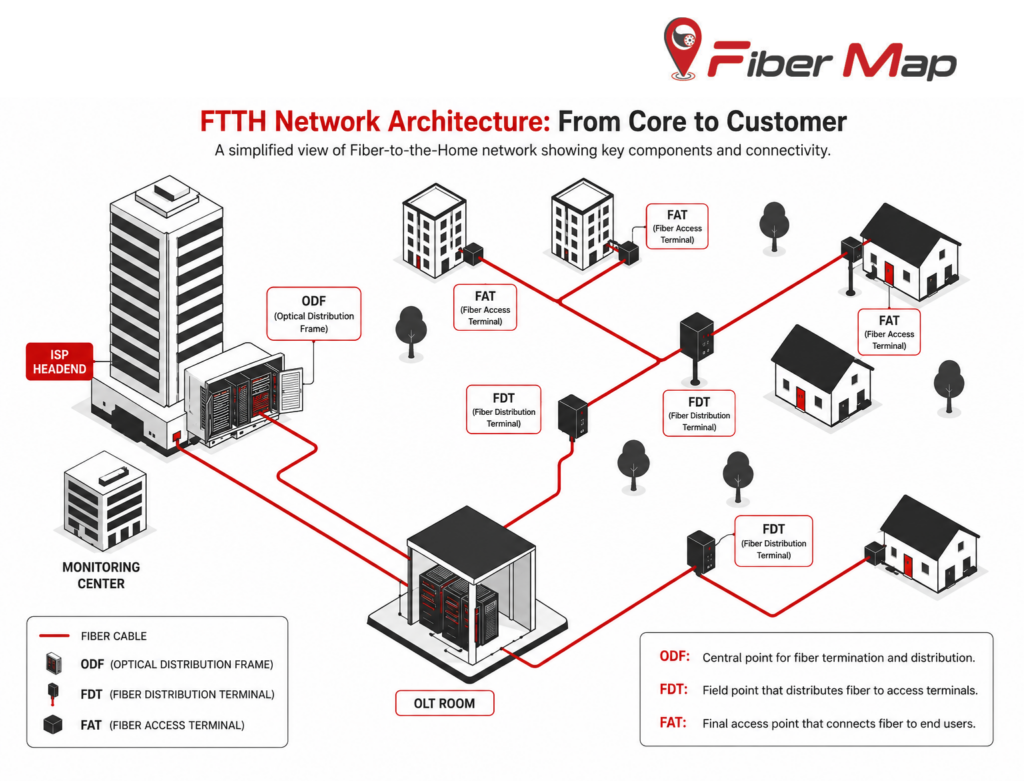
A standard FTTH network typically includes several core components:
- Optical Line Terminal (OLT)
- Optical Distribution Network (ODN)
- Fiber Distribution Terminals (FDT)
- Fiber Access Terminals (FAT)
- Splitters
- Optical Network Terminals (ONT)
The overall architecture is generally influenced by subscriber density, projected traffic demand, geographic conditions, and long-term scalability requirements.
The Importance of Feasibility Analysis
Before deployment begins, network feasibility assessment helps determine infrastructure viability and deployment efficiency.
Key evaluation areas often include:
- Population density
- Existing utility infrastructure
- Underground and aerial route conditions
- Service demand projections
- Expansion opportunities
In dense urban environments, fiber deployment can become increasingly complex due to narrow roadways, utility congestion, and irregular street layouts. Rural deployments, on the other hand, may involve long-distance routing challenges and infrastructure limitations.
Early-stage planning helps reduce future rerouting requirements and minimizes long-term operational costs.
Fiber Route Planning and Network Layout
Fiber route design is one of the most critical elements of FTTH deployment. The efficiency of the network often depends on how well the physical infrastructure is planned during the early stages.
Route planning commonly considers:
- Shortest feasible path
- Existing ducts and utility poles
- Right-of-way permissions
- Handhole and splice point placement
- Redundancy and backup routes
Poor route design can increase splice complexity, delay maintenance activities, and extend outage resolution times.
To improve planning accuracy, many ISPs now rely on GIS-based fiber mapping platforms that provide visual network layouts and centralized infrastructure visibility.
Split Ratios and PON Design Considerations
Split ratios determine the number of subscribers connected through a single OLT port within a PON architecture.
Common deployment configurations include:
- 1:16
- 1:32
- 1:64
Higher split ratios can reduce infrastructure costs but may also affect optical performance and future scalability.
Network design decisions are typically influenced by:
- Subscriber growth projections
- Optical budget limitations
- Service density
- Future bandwidth requirements
Proper splitter placement also contributes to simplified maintenance and improved fault isolation.
Infrastructure Components and Hardware Selection
The reliability of an FTTH network is heavily influenced by the quality and suitability of its infrastructure components.
Commonly deployed hardware includes:
- Single-mode fiber cables
- Patch panels
- Splitters
- Splice closures
- Fiber termination boxes
- OLTs and ONTs
Environmental conditions also influence deployment strategies.
For example:
- Underground networks require stronger cable protection
- Aerial deployments demand weather-resistant infrastructure
- High-temperature regions require durable enclosures
Scalable hardware selection helps reduce replacement costs during future network expansion.
Fiber Splicing and Signal Optimization
Every splice point within a fiber network introduces potential signal loss. As a result, splice quality plays a major role in overall network stability.
Efficient FTTH deployments typically focus on:
- Minimizing unnecessary splice points
- Maintaining proper bend radius standards
- Using accurate fusion splicing methods
- Performing regular OTDR testing
Poor splicing practices often contribute to:
- Signal attenuation
- Increased downtime
- Subscriber complaints
- Slower fault resolution
Accurate splice documentation also improves maintenance efficiency and network troubleshooting.
Network Documentation and Infrastructure Visibility
One of the most common operational challenges in FTTH networks is incomplete infrastructure documentation.
Many operators face issues such as:
- Unmapped splitters
- Missing splice records
- Outdated route diagrams
- Inaccurate customer connectivity data
Limited visibility often increases troubleshooting time and complicates maintenance operations.
Modern fiber mapping systems help centralize:
- Route documentation
- OLT-to-subscriber visibility
- Asset tracking
- Real-time infrastructure records
Improved visibility significantly enhances operational control and maintenance efficiency.
Testing and Long-Term Network Reliability
Before service activation, FTTH networks typically undergo multiple stages of validation and performance testing.
Common testing processes include:
- OTDR testing
- Optical power measurement
- Signal attenuation analysis
- End-to-end connectivity verification
These tests help identify:
- Fiber cuts
- Poor splice quality
- Connector faults
- Signal degradation issues
Long-term network reliability also depends on proactive maintenance strategies, monitoring systems, and scalable infrastructure planning.
Successful FTTH deployment depends on more than fiber installation alone. Scalable network architecture, accurate route planning, structured documentation, and real-time infrastructure visibility all contribute to long-term broadband reliability and operational efficiency.
Jaze Networks’ FiberMap helps ISPs streamline FTTH planning and fiber infrastructure management through visual network mapping, splitter tracking, route documentation, and centralized infrastructure visibility. By improving network accuracy and operational control, FiberMap supports faster deployments, simplified maintenance, and scalable broadband expansion.
Click here to see how FiberMap helps ISPs streamline FTTH network planning and fiber infrastructure management.