

Fiber networks are no longer just infrastructure—they are the foundation of digital economies. As demand from cloud, 5G, and IoT accelerates, network operators are under pressure to scale faster than ever.
Yet, many fiber projects still face delays, cost overruns, and operational inefficiencies. The problem isn’t investment—it’s strategy.
Without a structured approach, fiber mapping becomes fragmented, outdated, and unreliable—leading to long-term network challenges.
Let’s explore why fiber mapping fails—and how to get it right.
⚠️ Why Fiber Mapping Projects Fail
1. Disconnected and Outdated Data
Many operators still rely on spreadsheets, CAD files, or siloed tools. The result? Multiple versions of the same network.
When teams work with inconsistent data, planning errors multiply. A route marked as available might already be occupied, leading to rework, delays, and increased costs.
Outdated systems also create inefficiencies, forcing teams to duplicate work and rely on guesswork instead of accurate insights.
2. Manual Processes That Don’t Scale
Fiber networks are complex—every splice, node, and connection matters.
Manual documentation introduces small errors that grow over time. During outages, inaccurate maps make fault detection slower and less reliable.
As networks expand, manual workflows simply cannot keep up with the speed and scale required.
3. Poor Planning Before Deployment
A common mistake is treating fiber mapping as a documentation step instead of a planning tool.
Without detailed feasibility analysis—such as terrain data, infrastructure constraints, and route optimization—projects run into issues during construction.
In reality, planning quality determines deployment success, not just execution.
4. Lack of Real-Time Updates
What’s built in the field often differs from what’s recorded in the system.
Over time, this creates a gap between the physical network and its digital representation. This “visibility gap” leads to longer repair times, inefficient operations, and poor decision-making.
5. Short-Term Network Thinking
Many networks are designed for current demand—not future growth.
Without capacity planning and redundancy, networks quickly become constrained, requiring costly upgrades or redesigns.
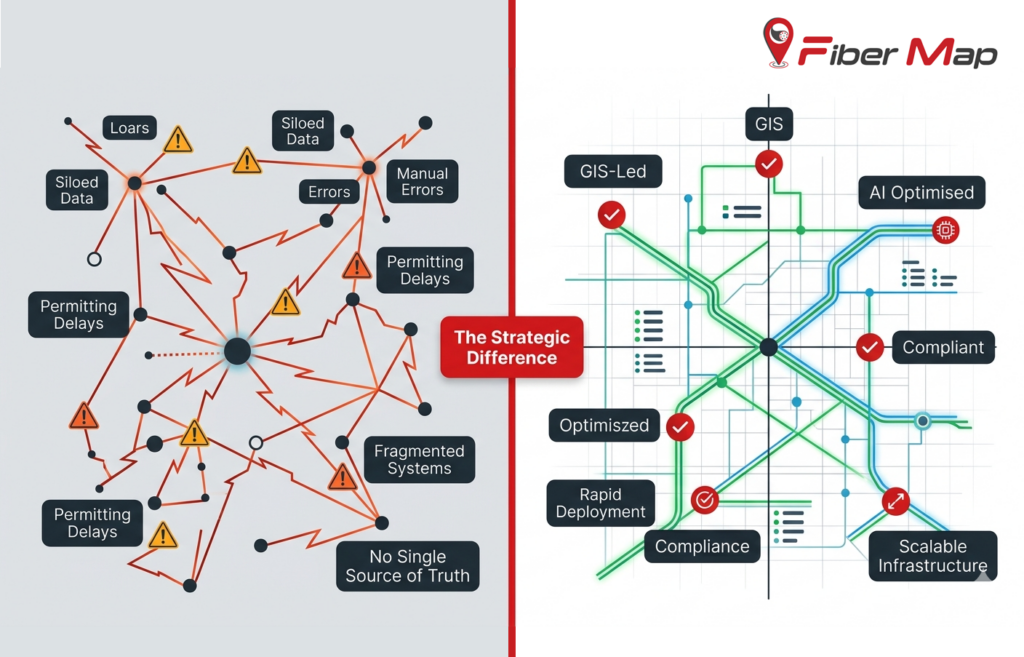
✅ 5 Best Practices for Future-Ready Fiber Mapping
To avoid these challenges, fiber mapping must evolve from static documentation to a dynamic, intelligent system.
1. Make GIS Your Single Source of Truth
A GIS-based fiber mapping platform provides a centralized, real-time view of your entire network.
It allows teams across planning, operations, and maintenance to work from the same dataset—eliminating inconsistencies and improving coordination.
With a unified system, decision-making becomes faster, more accurate, and more scalable.
2. Focus on Data Accuracy from Day One
Your network is only as good as your data.
Accurate inputs—collected from field surveys, validation workflows, and continuous updates—ensure your digital network reflects reality.
Reliable data reduces rework, improves planning precision, and speeds up troubleshooting.
3. Automate Planning and Design
Modern fiber networks require smarter planning.
Automation tools can analyze terrain, demand patterns, and infrastructure constraints to optimize routes and reduce costs.
Instead of relying on manual calculations, operators can simulate multiple scenarios and make data-driven decisions faster.
4. Integrate Field and Network Data
Field updates should not live in isolation.
By integrating field data directly into your mapping system, you ensure continuous synchronization between on-ground changes and digital records.
This eliminates mismatches and keeps your network map accurate at all times.
5. Plan for Growth and Resilience
Fiber networks are long-term assets.
Design with scalability in mind—include spare capacity, redundancy paths, and future expansion capabilities.
A future-ready network avoids costly rebuilds and supports evolving technologies like 5G, IoT, and edge computing.
🌐 The Shift: From Mapping to Network Intelligence
Fiber mapping is no longer just about drawing routes—it’s about creating a living, intelligent network model.
Operators who treat mapping as a strategic function gain:
- Faster deployments
- Lower operational costs
- Better network visibility
- Improved customer experience
On the other hand, those relying on outdated methods risk falling behind in an increasingly competitive landscape.
🚀 How FiberMap Enables Smarter Networks
At FiberMap, we believe fiber mapping should go beyond visualization.
By combining mapping, monitoring, and real-time intelligence, FiberMap helps operators:
- Maintain accurate, always-updated network data
- Bridge the gap between planning and operations
- Improve fault detection and response times
- Build scalable and future-ready fiber networks
Fiber network success doesn’t depend on how fast you build—it depends on how well you plan.
Without a clear strategy, mapping becomes a bottleneck. With the right approach, it becomes your biggest advantage.
The future of fiber isn’t just connected—it’s intelligently mapped.