
Choosing the right Passive Optical Network (PON) technology can make or break your fiber deployment strategy. Whether you’re upgrading an existing network or planning a greenfield FTTH rollout, understanding the differences between EPON, GPON, XG-PON, and XGS-PON is critical for long-term success.
This guide breaks down each PON variant in plain terms—no jargon overload—so you can make an informed decision based on bandwidth needs, budget, and scalability.
What is Passive Optical Network (PON) Technology?
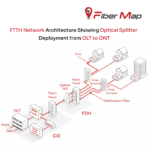
PON is a point-to-multipoint fiber access architecture that uses passive optical splitters to deliver data from a single Optical Line Terminal (OLT) to multiple Optical Network Units (ONUs) or Optical Network Terminals (ONTs). Unlike active networks, PON eliminates the need for powered equipment between the OLT and end users, reducing both operational costs and maintenance complexity.
The key PON variants—EPON, GPON, XG-PON, and XGS-PON—differ in standards, bandwidth capacity, and target applications. Let’s break them down.
GPON: The Industry Standard for FTTH
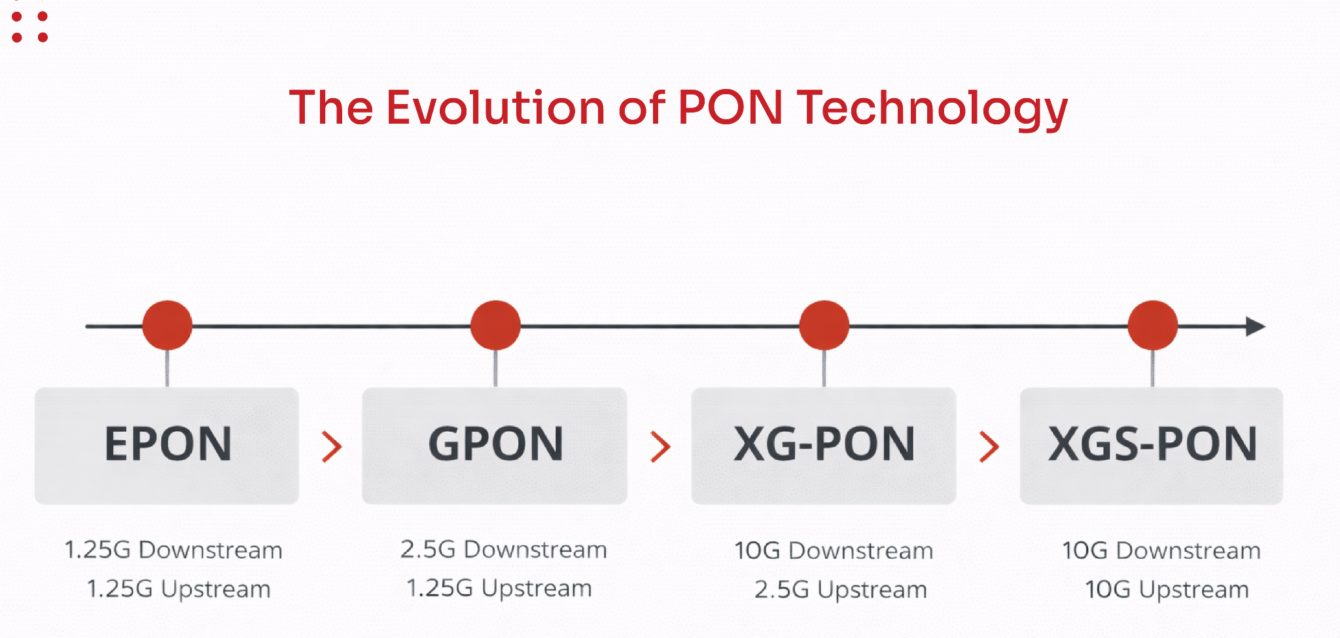
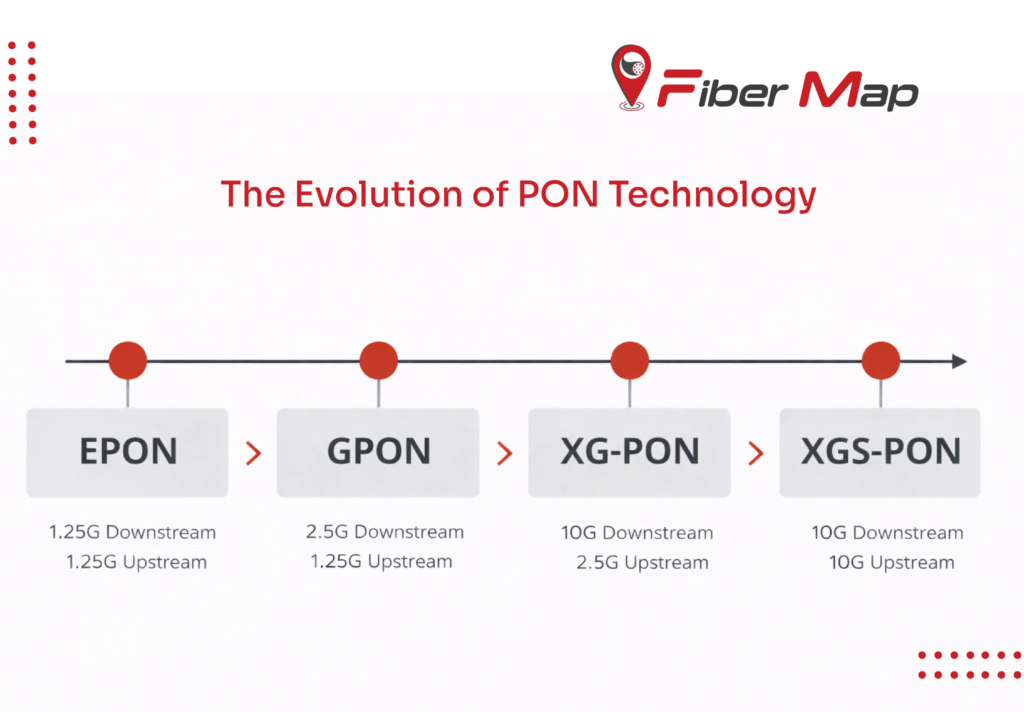
GPON (Gigabit Passive Optical Network) is based on the ITU-T G.984 standard and remains the most widely deployed PON technology globally. It delivers 2.488 Gbps downstream and 1.244 Gbps upstream, making it ideal for residential broadband and triple-play services (voice, video, data).
Key Technical Specs:
- Downstream: 2.488 Gbps | Upstream: 1.244 Gbps (asymmetric)
- Wavelengths: 1490 nm (downstream), 1310 nm (upstream)
- Split ratios: 1:32, 1:64, up to 1:128
- Max distance: 20 km
- Bandwidth efficiency: ~90%
Best For: Urban FTTH deployments, enterprise networks, video-on-demand services
GPON’s maturity and efficiency made it the go-to choice for telecom operators worldwide. However, as bandwidth demands surge with 4K streaming and cloud services, its limitations are becoming apparent.
EPON: The Cost-Effective Ethernet Alternative
EPON (Ethernet Passive Optical Network) follows the IEEE 802.3ah standard and is built on native Ethernet protocols. This makes it simpler to integrate with existing Ethernet infrastructure, particularly in enterprise and campus environments.
Key Technical Specs:
- Symmetric bandwidth: 1.25 Gbps (10G-EPON offers 10 Gbps)
- Wavelengths: 1490 nm (downstream), 1310 nm (upstream)
- Split ratios: 1:16, 1:32, up to 1:64
- Max distance: 20 km
- Bandwidth efficiency: ~70%
Best For: Small to mid-sized ISPs, campus networks, enterprise intranets
EPON’s main advantage is low cost and straightforward configuration. However, it offers lower bandwidth efficiency compared to GPON and is less suitable for high-density deployments.
XG-PON: Bridging the Gap to 10G
XG-PON (10 Gigabit Passive Optical Network) is an ITU-T G.987 standard designed to meet growing bandwidth demands. It provides 10 Gbps downstream and 2.5 Gbps upstream, making it a solid upgrade path for operators already running GPON.
Key Technical Specs:
- Downstream: 10 Gbps | Upstream: 2.5 Gbps (asymmetric)
- Wavelengths: 1577 nm (downstream), 1270 nm (upstream)
- Split ratios: 1:64, up to 1:128
- Max distance: 20 km
- Coexists with GPON via WDM
Best For: 4K/8K video streaming, cloud computing, high-bandwidth enterprise networks, 5G mobile backhaul
XG-PON significantly improves downstream capacity, but the asymmetric design (10G down, 2.5G up) can create upstream bottlenecks in applications like live streaming or cloud backup.
XGS-PON: The Future-Proof Symmetric Solution
XGS-PON (10 Gigabit Symmetric Passive Optical Network) is the next evolution, based on ITU-T G.9807.1. Unlike XG-PON, it delivers 10 Gbps in both directions, eliminating upstream bottlenecks entirely.
Key Technical Specs:
- Symmetric bandwidth: 10 Gbps downstream and upstream
- Wavelengths: 1577 nm (downstream), 1270 nm (upstream)
- Split ratios: 1:64, up to 1:256
- Max distance: 20–40 km
- Coexists with GPON via WDM
Best For: Smart cities, data center interconnects, 10G broadband, high-upload applications (video conferencing, cloud storage, 5G fronthaul)
XGS-PON is the long-term choice for operators planning future-proof networks. Its symmetric design supports emerging applications like remote work, telemedicine, and real-time collaboration.
PON Technology Comparison: Side-by-Side
| Feature | EPON | GPON | XG-PON | XGS-PON |
| Standard | IEEE 802.3ah | ITU-T G.984 | ITU-T G.987 | ITU-T G.9807.1 |
| Bandwidth | 1.25 Gbps | 2.488/1.244 Gbps | 10/2.5 Gbps | 10/10 Gbps |
| Symmetry | Symmetric | Asymmetric | Asymmetric | Symmetric |
| Split Ratio | 1:32 (max 1:64) | 1:64 (max 1:128) | 1:64 (max 1:128) | 1:64 (max 1:256) |
| Cost | Low | Medium | Higher | High |
| Efficiency | ~70% | ~90% | ~90% | ~90% |
How to Choose the Right PON Technology
PON technology continues to evolve, from gigabit-class systems to 10G symmetric architectures. The right choice depends on your current needs, budget, and growth plans. GPON remains the workhorse for residential broadband, while XGS-PON represents the future of high-capacity fiber networks.
Choose EPON if:
- You need a low-cost solution for campus or enterprise networks
- Ethernet compatibility is a priority
- Bandwidth demands are moderate
Choose GPON if:
- You’re deploying FTTH for residential broadband
- You need proven, stable technology with high efficiency
- Downstream traffic dominates (streaming, video services)
Choose XG-PON if:
- You need 10G downstream capacity
- You’re upgrading from GPON and want coexistence
- Upstream demands are moderate
Choose XGS-PON if:
- You need symmetric 10G bandwidth
- You’re planning for future high-bandwidth applications
- You want the most scalable, future-proof option
PON and FiberMap: Complete Visibility for Your Optical Network
Managing PON infrastructure at scale requires more than just bandwidth—you need complete visibility. FiberMap provides real-time mapping of your entire PON deployment, from OLT to ONU, including splitter locations, fiber routes, and subscriber connections.
With FiberMap, you can:
- Visualize your PON architecture on a single interactive map
- Track splice points and fiber availability at the core level
- Troubleshoot outages faster with end-to-end route tracing
- Plan capacity upgrades with accurate network data
Whether you’re running GPON, XGS-PON, or a mix of both, FiberMap gives you the visibility to operate efficiently.
PON technology continues to evolve, from gigabit-class systems to 10G symmetric architectures. The right choice depends on your current needs, budget, and growth plans. GPON remains the workhorse for residential broadband, while XGS-PON represents the future of high-capacity fiber networks.