
As demand for high-speed internet continues to grow, fiber-optic networks have become the backbone of modern connectivity. From streaming and remote work to cloud services and smart homes, users expect fast, stable, and future-ready broadband. Among the most widely deployed fiber architectures are FTTH (Fiber to the Home) and FTTB (Fiber to the Building). While both rely on fiber-optic technology, the way fiber is delivered to end users differs significantly.
Understanding these differences helps ISPs, network planners, property developers, and businesses choose the right approach based on performance needs, cost, and deployment conditions.
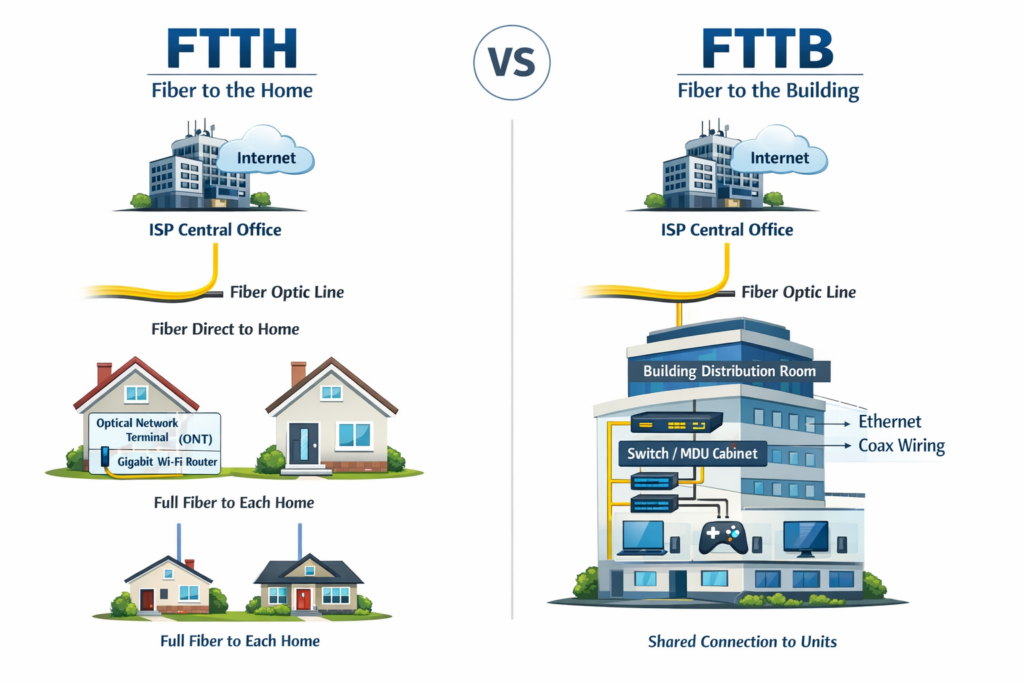
What Is FTTH (Fiber to the Home)?
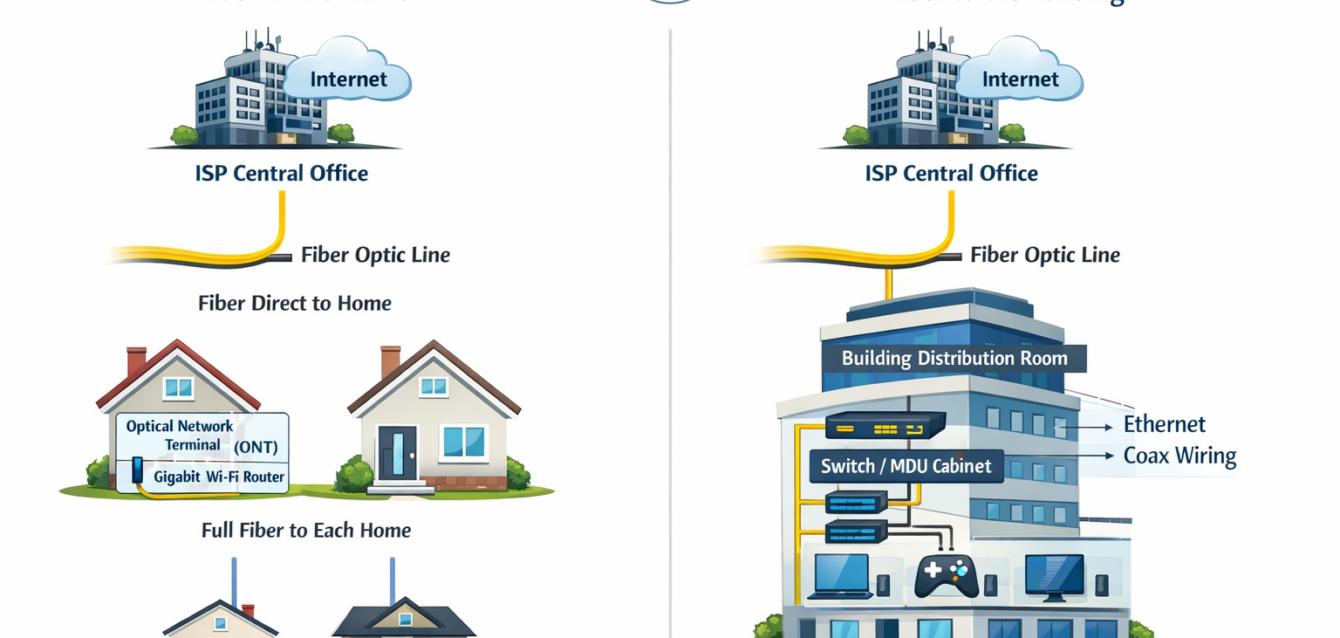
FTTH refers to a network architecture where fiber-optic cables run directly from the service provider’s network all the way into individual homes or offices. The fiber terminates inside the user’s premises, connecting directly to an optical network terminal.
Because the entire connection is fiber-based, FTTH delivers the highest possible bandwidth, lowest latency, and most consistent performance. There is no reliance on copper, coaxial, or legacy wiring in the last mile, which means minimal signal loss and fewer performance bottlenecks.
FTTH is ideal for environments where users demand high upload and download speeds, such as homes with multiple devices, businesses using cloud applications, or locations planning for future services like smart infrastructure and advanced streaming.
Key characteristics of FTTH:
- Fiber runs directly into each home or unit
- Supports very high and symmetrical speeds
- Low latency and stable performance
- Highly future-proof architecture
The main challenge with FTTH is deployment cost and complexity, as fiber must be installed individually to each location.
What Is FTTB (Fiber to the Building)?
FTTB brings fiber-optic connectivity up to a shared point within a building, such as a basement, communications room, or utility area. From there, the final connection to individual apartments or offices is made using existing internal wiring like Ethernet, coaxial cable, or copper lines.
This approach is commonly used in apartment buildings, offices, hotels, and multi-dwelling units, where running fiber to each individual unit may not be practical or cost-effective.
While FTTB still benefits from fiber’s high capacity up to the building, the performance inside individual units can vary depending on the quality of internal wiring and how bandwidth is shared among users.
Key characteristics of FTTB:
- Fiber reaches the building, not individual units
- Final connection uses existing in-building wiring
- Faster and more cost-effective deployment
- Suitable for dense urban environments
FTTB offers strong performance for everyday internet use but may not match the consistency or scalability of full fiber connections.
FTTH vs FTTB: Key Differences
| Aspect | FTTH | FTTB |
| Fiber reach | Directly into each unit | Up to the building |
| Last-mile medium | Fiber | Ethernet / Coax / Copper |
| Speed potential | Very high | High but shared |
| Latency | Very low | Slightly higher |
| Deployment cost | Higher | Lower |
| Scalability | Excellent | Moderate |
| Best suited for | Homes, future-ready networks | Apartments, offices |
When FTTH Makes Sense
FTTH is the preferred option when long-term performance, scalability, and service quality are top priorities. It is best suited for new residential developments, premium broadband offerings, and areas planning for future digital services. ISPs investing in FTTH benefit from lower maintenance, fewer performance issues, and the ability to support evolving bandwidth demands.
When FTTB Is the Right Choice
FTTB is a practical solution for buildings where deploying fiber to every unit is difficult or costly. It allows ISPs to deliver fiber-grade connectivity quickly while leveraging existing infrastructure. For many urban buildings and commercial environments, FTTB strikes a balance between performance and cost efficiency.
Both FTTH and FTTB are effective fiber network architectures, each serving different deployment needs. FTTH offers unmatched performance and long-term scalability by delivering fiber directly to end users. FTTB provides a faster, more economical way to extend fiber connectivity into shared buildings. Choosing the right model depends on factors such as budget, building type, user demand, and future growth plans.
FibreMap helps ISPs visualize, document, and manage fiber networks with clarity—from core infrastructure to last-mile connections. By providing a single, accurate network view, FibreMap enables better planning, faster fault identification, and smoother coordination between planning, operations, and field teams. Whether deploying FTTH or FTTB, FibreMap supports smarter, data-driven network decisions. Click here to learn more.