

Fiber to the Home (FTTH) is no longer a future investment—it is a present-day necessity for Internet Service Providers (ISPs). With rising demand for high-speed internet, smart homes, OTT streaming, and remote work, customers expect uninterrupted connectivity. However, many FTTH network designs that look perfect on paper fail when exposed to real-world conditions.
So the real question is: Is your FTTH network truly ready for the field?
Let’s explore the key design elements, common challenges, and how ISPs can build a future-ready FTTH network.
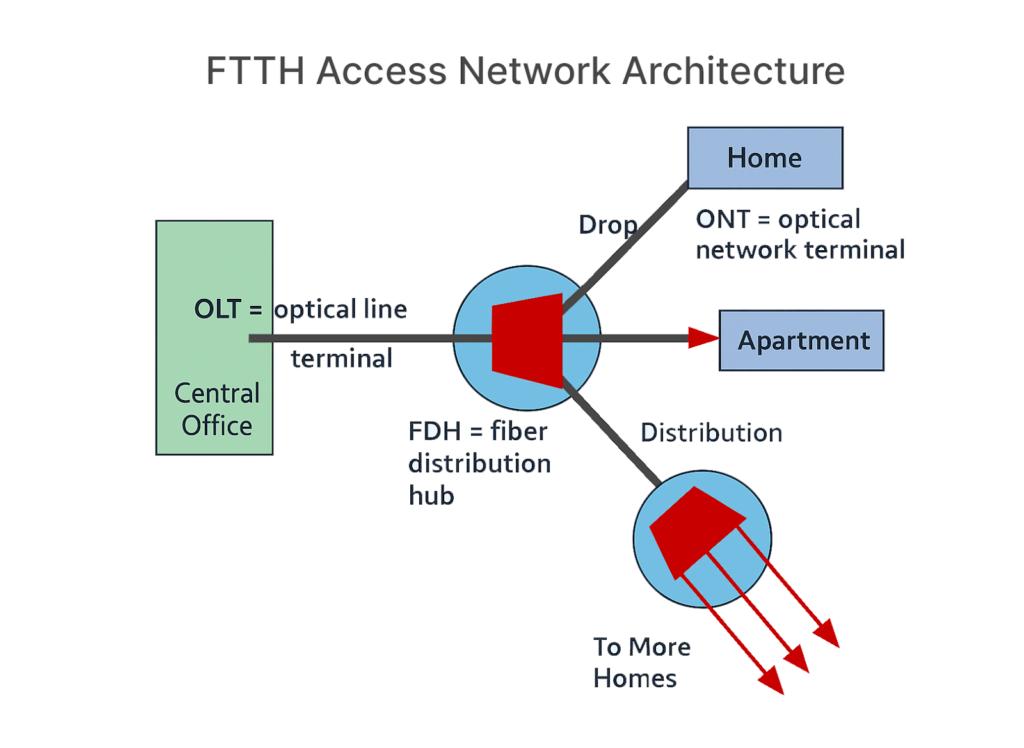
1. The Gap Between Theoretical Design and Ground Reality
On diagrams, FTTH networks appear clean and efficient—straight fiber routes, evenly distributed splitters, and smooth signal flow. But the real world is far from perfect.
Common on-ground issues include:
- Unplanned road crossings
- Congested utility ducts
- Irregular building layouts
- Restrictions from local authorities
Many ISPs face delays, rework, and signal loss because these real-world obstacles were not considered during the planning phase. A practical FTTH network design must adapt to physical, geographical, and regulatory constraints.
2. Scalability: Designing for Today and Tomorrow
One of the biggest mistakes in FTTH deployment is designing only for current demand. Subscriber growth is unpredictable, and bandwidth usage continues to increase rapidly.
Your FTTH design must support:
- Easy addition of new customers
- Expansion into new service areas
- Future bandwidth upgrades
If your splitter ratios, duct capacity, or core network equipment are already at their limits, scaling becomes expensive and disruptive. A scalable FTTH network ensures long-term ROI and faster service rollouts.
3. Accurate Fiber Mapping and Documentation
Many network issues arise not because of faulty equipment—but due to poor documentation. Without accurate fiber maps, ISPs struggle with:
- Fault localization
- Maintenance delays
- Incorrect splicing
- Service outages lasting longer than necessary
A real-world ready FTTH design includes digitized fiber maps, real-time network visibility, and updated route documentation. This enables faster troubleshooting and better operational efficiency.
4. Signal Loss and Power Budget Planning
FTTH networks depend heavily on optical signal strength. Poor power budgeting leads to weak signals, customer complaints, and reduced network reliability.
Key contributors to signal loss include:
- Excessive fiber bends
- Long fiber routes
- Multiple connector points
- Poor quality splicing
Every FTTH design should include a realistic optical power budget calculation that factors in actual distances, splitter losses, and environmental conditions—not just textbook values.
5. Redundancy and Network Reliability
Real-world networks fail—due to fiber cuts, power outages, equipment failure, or natural disturbances. If your FTTH design lacks redundancy, a single fault can disconnect an entire neighborhood.
A resilient FTTH network includes:
- Backup fiber routes
- Redundant power supply
- Failover at the core network level
This ensures higher uptime, better SLA compliance, and stronger customer trust.
6. Last-Mile Challenges in FTTH Deployment
The last mile is often the most complex and expensive part of FTTH deployment. Every building type presents a different challenge—apartments, villas, commercial blocks, and gated communities all require customized designs.
Real-world last-mile challenges include:
- Permission issues with building management
- Poor internal ducting
- Long vertical drops
- Risk of cable damage
A flexible FTTH network design accounts for these variations without affecting performance or customer experience.
7. Role of Automation and Network Intelligence
Modern ISPs can no longer rely on spreadsheets and manual tracking. Automated network planning and management tools play a vital role in making FTTH designs field-ready.
With intelligent network platforms, ISPs can:
- Visualize fiber routes digitally
- Track live network performance
- Instantly identify faults
- Optimize capacity utilization
Automation not only reduces human error but also speeds up deployments and improves service quality.
8. Customer Experience Starts with Network Design
No marketing campaign can fix a poor network experience. Slow speeds, frequent disconnections, and long downtimes directly impact churn rates.
A real-world ready FTTH design ensures:
- Consistent bandwidth delivery
- Minimal downtime
- Faster installations
- Quick fault resolution
When your foundation is strong, customer satisfaction follows naturally.
9. Compliance and Safety Considerations
FTTH deployment must follow telecom regulations, safety standards, and local government policies. Poor compliance can result in penalties, forced network changes, or shutdowns.
Your network design should align with:
- Right-of-way regulations
- Electrical safety norms
- Fiber handling standards
- Municipal infrastructure rules
Compliance protects both your business and your customers.
10. Future-Proofing Your FTTH Network
Technology is evolving fast—Wi-Fi 6, 10G PON, smart cities, and IoT will further increase fiber demand. A future-ready FTTH design focuses on:
- Higher fiber counts
- Flexible splitter architecture
- Efficient space utilization
- Support for next-gen access technologies
Future-proofing saves enormous costs in re-engineering later.
Designing an FTTH network is not just about connecting fibers—it’s about creating a scalable, resilient, and service-ready ecosystem. The gap between lab-perfect designs and real-world deployment is where most networks fail.
By focusing on scalability, accurate mapping, power budgeting, redundancy, automation, and last-mile realities, ISPs can ensure that their FTTH networks are not only technically sound—but also commercially successful.